If you ask a large AI model what the emerging trends in medicine will be, its answer will certainly include AI-driven medicine, digital medicine, longevity medicine, digital twins, brain–computer interfaces, and other forward-looking medical fields. I believe this answer is absolutely right!!!
Medical informatics was once misconstrued as merely “the application of computer technology to medicine” and remained at the margins of the medical disciplines for many years. However, as medicine enters an era defined by intensive data use, intelligent technologies, and digital transformation, medical informatics is evolving from a discipline focused on technical support into a foundational field that connects medicine, data, artificial intelligence, and clinical decision making. It is also moving steadily toward the center of academic development in medicine.
AI in medicine is not simply “AI + medicine.” Its underlying foundation actually requires an entire chain: data standards → data governance → data semantics → data integration → algorithms → knowledge representation → clinical validation → decision support → feedback learning. This complete system is, in essence, the research domain of medical informatics. AMIA has also clearly stated that medical informatics overlaps with data science, big data, data analytics, and health information management, but informatics places greater emphasis on organizing these capabilities to improve health and healthcare services.
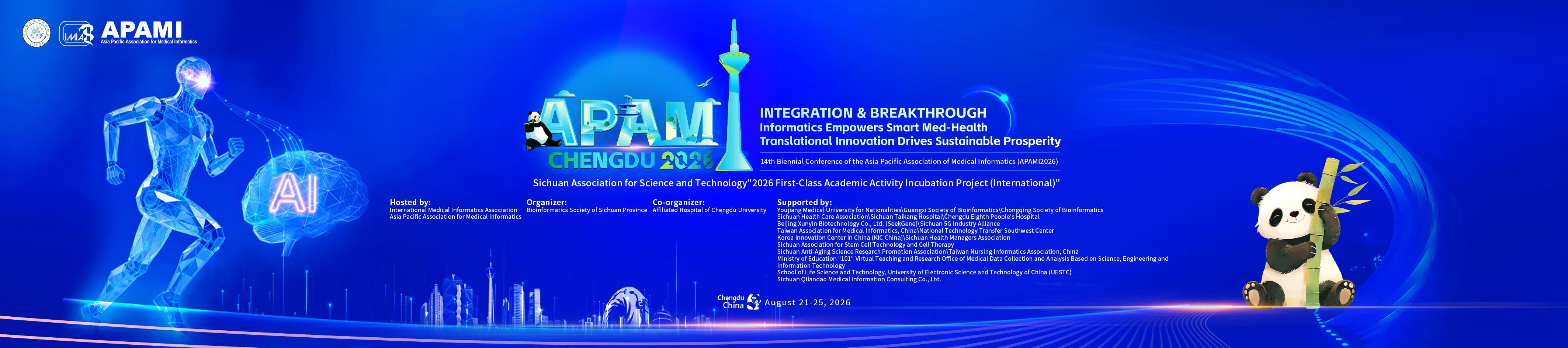
Nearly 200 experts in medical informatics from 15 countries, including Germany, Finland, the Philippines, South Korea, the United States, Bangladesh, Nepal, Australia, Japan, Thailand, India, the United Kingdom, Vietnam, and Pakistan, will gather to discuss key frontiers in medical informatics. These include medical artificial intelligence and large model applications, nursing informatics and digital health, computational geroscience and healthy longevity, and translational informatics and industry.
The conference will also feature the International Forum for Emerging Leaders in Medical Informatics, which will facilitate in-depth discussion and exchange on the following ten issues (specific presentation topics will be available on the conference website):
- Medical semantic reasoning and the development of trustworthy AI
- Healthcare data standardization and cross-institutional interoperability
- Clinically compliant applications of generative AI and AI agents
- Modeling and simulation of digital twins in precision medicine
- Challenges in implementing medical AI across clinical specialties
- Key mechanisms in older-adult health and aging informatics
- Building digital capabilities in nursing and implementing frontline innovation
- Healthcare privacy and security, and the trusted use of data
- Clinical translation and industrial implementation of medical informatics outcomes
- Cross-regional and international collaboration in the development of medical informatics
Keynote Speakers
The conference’s two keynote speakers come from two universities renowned for their medical informatics departments. One is the University at Buffalo, a leading birthplace of applied ontology and biomedical ontology worldwide. It is home to the National Center for Ontological Research (NCOR) and produced the internationally influential top-level ontology standard, Basic Formal Ontology (BFO). The other is the University of Utah, which established the first independently organized department of medical informatics within a U.S. medical school. Its founder, Homer R. Warner, is regarded as the father of medical informatics, and AMIA’s highest honor, the Homer R. Warner Award, is named after him. The conference’s two keynote speakers are the chairs of medical informatics at these universities and internationally authoritative scholars in the field.
Professor Peter L. Elkin
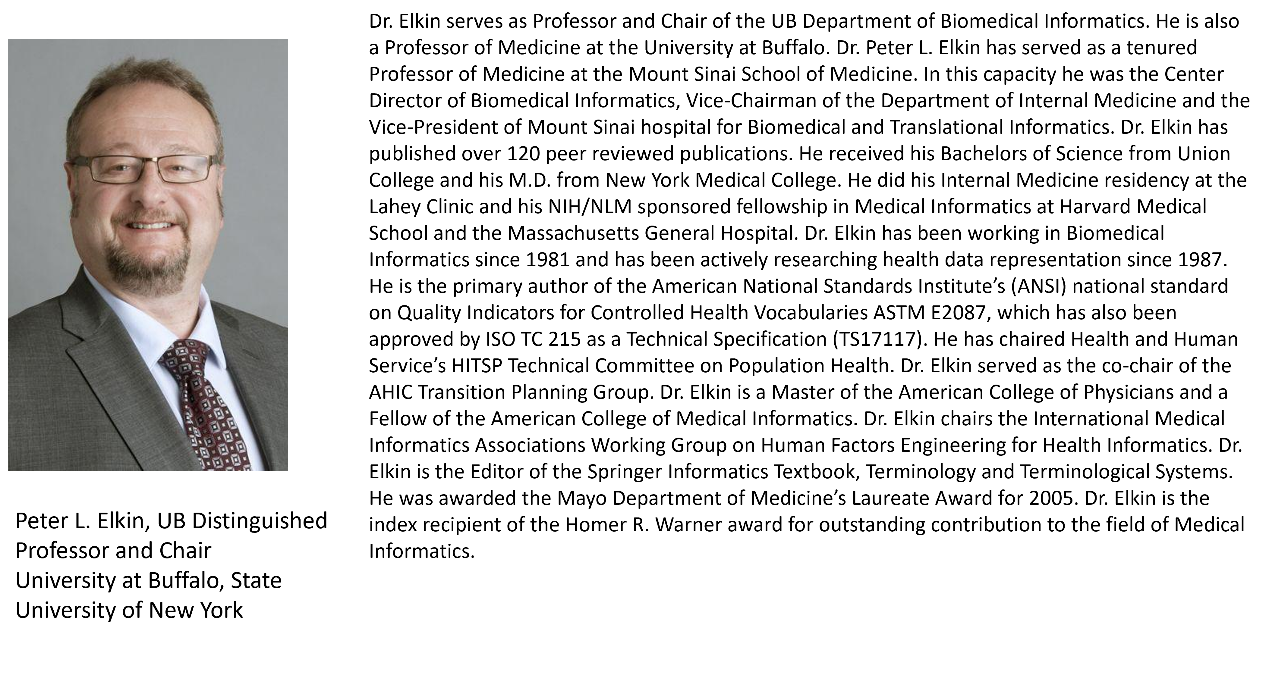
Professor Peter L. Elkin is a pioneer in semantic AI for medicine and a recipient of the Homer R. Warner Award, the highest honor in medical informatics. His core research focuses on semantic representation of medical knowledge, medical ontologies, clinical natural language processing, healthcare data standardization, and interoperability. He has long worked to address major industry challenges, including hallucinations in healthcare AI, unreliable reasoning, and disconnected data. His landmark achievement is the development of the SCAI semantic clinical artificial intelligence framework. Through a semantic reasoning layer and knowledge-grounding techniques, SCAI substantially improves the accuracy and stability of clinical AI reasoning. It enables controlled knowledge updates without fine-tuning the foundation model, providing a core technical paradigm for trustworthy medical large models and intelligent clinical decision-making.
His presentation is titled: Semantic Clinical Artificial Intelligence: How Semantic-Based Reasoning Can Improve the Performance of AI on Many Tasks.
Professor Yves A. Lussier
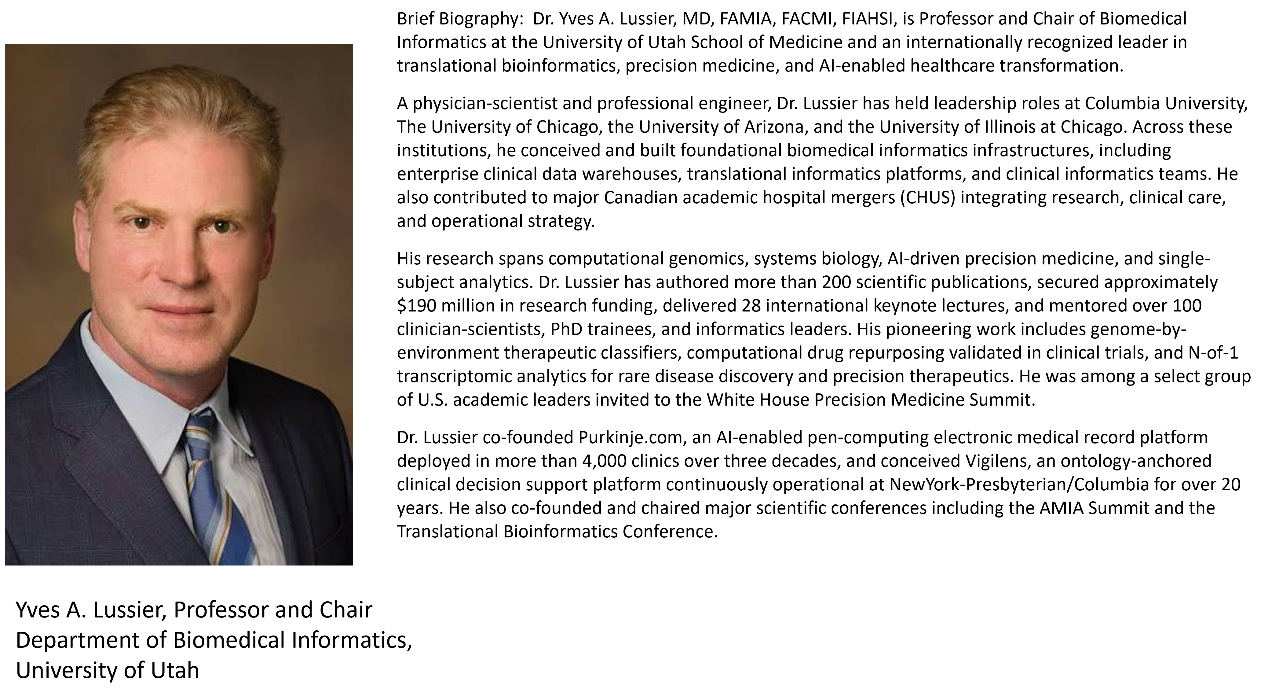
Professor Yves A. Lussier is an internationally recognized authority in translational bioinformatics and precision medicine, with academic training as both an engineer and a clinician. His long-term research focuses on ontology-based representation of medical knowledge, multi-omics network modeling, computational precision medicine, drug repositioning, and phenomics. He created the N-of-1-pathways framework and is particularly skilled at integrating clinical electronic health records, large-scale genomic data, and disease mechanisms, advancing computational models from algorithmic prediction to validation in vitro, in animals, and even in clinical trials. Early in his career, he participated in extending the SNOMED medical terminology system and proposed semantic filtering of medical records, making foundational contributions to clinical semantic standards and knowledge engineering for electronic health records.
His presentation is titled: The Missing Variable in Clinical AI: From Self-Controlled Pathophysiology to Uncertainty-Aware Machine Learning.
An Event You Cannot Miss
The content of the conference will be highly interesting and diverse. For scholars and companies seeking to make achievements and contributions in the future of intelligent medicine, this is an event you simply cannot miss!